


TANZANIA
TANZANIA NATIONAL ACTION PLAN ON WOMEN, PEACE AND SECURITY (2025–2029)
Introduction
The United Republic of Tanzania adopted its first National Action Plan (NAP) on Women, Peace and Security (WPS) for the period of 2025 - 2029. The NAP provides a national framework for implementing United Nations Security Council Resolution (UNSCR) 1325 and subsequent WPS resolutions, while aligning with Tanzania’s constitutional commitments, national development priorities, and regional and international obligations. The plan seeks to strengthen women’s participation and leadership in peace and security processes while enhancing protection, prevention, and gender-responsive recovery mechanisms.
Objectives of the NAP
The Tanzania NAP is guided by six key objectives:
a. To implement existing international, continental, regional and national frameworks on Women, Peace and Security.
b. To increase women’s participation and leadership in national and local socio-economic, political, peacekeeping and peacebuilding structures and processes, including within the security sector and judiciary.
c. To protect women and girls from all forms of violence and discrimination.
d. To strengthen conflict prevention and management systems for sustained peace.
e. To mainstream gender in disaster risk management.
f. To strengthen monitoring, evaluation and reporting on the Women, Peace and Security Agenda in Tanzania.
Context
Tanzania has long maintained a reputation as one of the most peaceful countries in Africa and has historically played a significant role in regional peacebuilding efforts. The country has hosted refugees and asylum seekers from neighbouring countries since the 1970s and continues to contribute personnel to United Nations and African Union peacekeeping missions. Despite this stability, challenges remain regarding women’s participation in decision-making, gender-based violence, discriminatory social norms, child marriage, and women’s access to justice.
The NAP recognises emerging threats including climate change, human trafficking, youth unemployment, violent extremism, and regional instability, all of which have gendered impacts. The plan therefore adopts a comprehensive approach to ensuring women’s meaningful participation in preventing and responding to these challenges while strengthening national peace and security systems.
Women’s Participation in Peace and Security
The NAP highlights both progress and continuing gaps in women’s participation across governance, security, and justice sectors. Tanzania has made notable advances in women’s political leadership, including the election of President Samia Suluhu Hassan, the country’s first female Head of State. Women’s representation has also increased in parliament, the judiciary, and public service institutions including having the first female minister of defence. Nevertheless, women remain underrepresented in many leadership positions, particularly within security institutions and local decision-making structures as most security institutions have progressively been headed by men since independence.
The NAP therefore prioritises efforts to increase women’s recruitment, retention, advancement, and leadership withinsecurity services, police and military institutions, peacekeeping operations, conflict prevention and mediation structures, local governance mechanisms, judicial institutionsand community-based peacebuilding initiatives. The plan further recognises the importance of addressing social norms and institutional barriers that continue to limit women’s participation and leadership opportunities.
Inclusive Development Process
One of the strengths of Tanzania’s NAP is the inclusive and participatory approach adopted during its development. The process began in 2019 through collaboration between the Government of Tanzania, the Office of the United Nations Special Envoy for the Great Lakes Region, the Mwalimu Nyerere Foundation (MNF), and UN Women. A dedicated Women, Peace and Security National Taskforce was established in 2020 to guide the process. The Taskforce brought together representatives from government ministries, security institutions, civil society organisations, the African Women Leaders Network (AWLN), UN Women, and other stakeholders.
A nationwide situational analysis was conducted across eleven regions in Mainland Tanzania and Zanzibar. The assessment engaged more than 1,800 respondents, including women, men, community leaders, local authorities, civil society organisations, and security actors. The findings informed the identification of priority areas and strategic interventions within the NAP. Validation workshops subsequently brought together over 250 participants representing women-led organisations, academia, media, religious institutions, government agencies, and persons with disabilities. This broad engagement helped ensure that the final NAP reflects diverse perspectives and responds to realities experienced by women and communities across Tanzania.
United Nations Peacekeeping Contributions
Tanzania is an active contributor to United Nations peacekeeping operations and has consistently deployed both military and police personnel to missions including United Nations Organization Stabilization Mission in the Democratic Republic of the Congo (MONUSCO), United Nations Mission in South Sudan (UNMISS) and United Nations Interim Security Force for Abyei (UNISFA).
According to the NAP, as of October 2024 Tanzania contributed approximately 1,555 peacekeepers, including 190 women peacekeepers (approximately 12.1%), making Tanzania one of Africa’s leading troop contributing countries. The NAP specifically highlights the need to increase women’s representation and leadership within peacekeeping operations and to strengthen gender-responsive peacekeeping practices.
UN Statistics
2025 Data
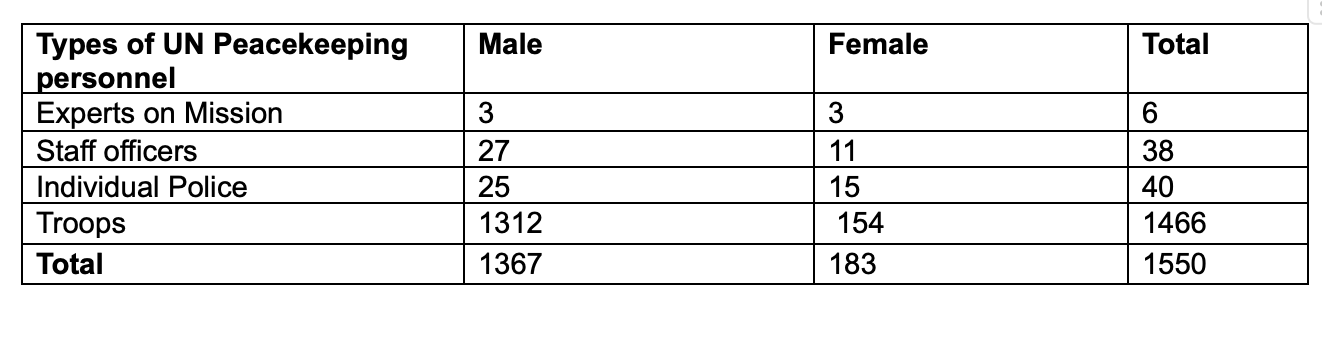
Types of UN Peacekeeping personnel
As of March 2025, Tanzania contributed a total of 1550 Peacekeeping personnel (of which 183 were female):
Australia's ranking as a contributor of personnel to UN peacekeeping missions: 10
2026 Data (totals only available)
Experts on Missions 7
Formed Police Units 0
Individual Police 26
Staff Officers 37
Troops 1461
Total 1531
Relevance to SecurityWomen’s Mission
Tanzania’s NAP aligns with SecurityWomen’s mission of promoting women’s participation, leadership and advancement across security, defence, and peacebuilding sectors. The plan prioritises increasing women’s representation within the security services, peacekeeping operations, judiciary, and decision-making institutions while addressing barriers created by discriminatory norms and gender-based violence.
Particularly relevant to SecurityWomen is the NAP’s focus on women’s leadership in conflict prevention, mediation, peacebuilding, and security governance, alongside commitments to strengthen women’s participation in national and international peacekeeping efforts.
References
1. United Republic of Tanzania. National Action Plan on Women, Peace and Security (UNSCR 1325) 2025–2029August 2025 found at https://wpsfocalpointsnetwork.org/wp-content/uploads/2025/10/The-United-Republic-of-Tanzania-NAP-WPS-2025-6.pdf
Contributions of Uniformed Personnel to UN by Country, Mission, and Personnel Type (March 2025): 05-Missions Detailed By Country
https://peacekeeping.un.org/sites/default/files/05_missions_detailed_by_country_84_march_2025.pdf
UN data 2026