


Cambodia – National Action Plan on Women, Peace and Security (NAP-WPS)
Status
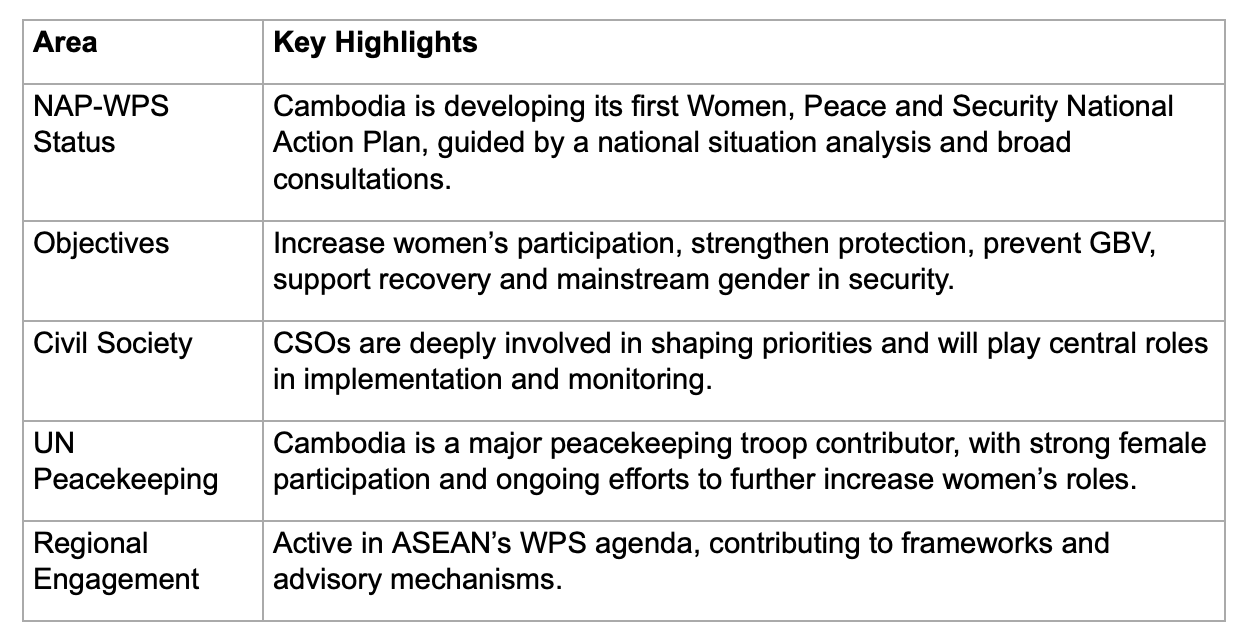
Cambodia is in the process of developing its first ever National Action Plan (NAP) on Women, Peace and Security (WPS). The plan aims to translate international commitments — especially UN Security Council Resolution 1325 and the ASEAN Regional Plan of Action on WPS — into concrete national policies and actions. The Government, led by the Ministry of Women’s Affairs, is working with UN Women, The Asia Foundation and other partners to draft and finalise the plan. A Situation Analysis Report was completed to inform this process, and national consultations with government institutions, civil society, UN agencies, youth and academia were conducted to shape priorities.
As of late 2025, Cambodia had not yet publicly published a final NAP-WPS document, but the groundwork and framework are underway.
Purpose
Cambodia’s National Action Plan on Women, Peace and Security (NAP-WPS) operationalises the global Women, Peace and Security agenda (UNSCR 1325 and subsequent resolutions) and the ASEAN Regional Plan of Action on WPS. It aims to strengthen women’s meaningful participation in peace and security decision-making, prevent and respond to gender-based violence, and ensure gender-responsive security, peacekeeping and recovery efforts.
Context
Cambodia is emerging from a conflict-affected past and is now a significant contributor to UN peacekeeping operations. While the country faces no active armed conflict, women continue to experience gender-specific insecurity related to violence, trafficking, migration, disasters, and economic vulnerability. At the same time, Cambodia has growing regional and international responsibilities, particularly through UN peacekeeping and ASEAN leadership.
Overall Goal
To ensure that women and girls in Cambodia participate equally in peace and security processes, are protected from violence, and benefit from gender-responsive prevention, peacekeeping, relief, and recovery systems at local, national, and international levels.
The NAP-WPS is designed to:
• Localise global WPS commitments — translating UNSCR 1325 and ASEAN WPS frameworks into national strategies.
• Strengthen gender-responsive policies across peace and security sectors, including armed forces, police, governance, and disaster response.
• Address gendered impacts of conflict, insecurity, and crises (e.g., violence, displacement, trafficking).
• Ensure women’s meaningful participation in prevention, protection, peacebuilding, and peacekeeping at all levels (local, national, and international).
Core Objectives (Inferred from Situation Analysis & Consultation Themes)
While a final NAP has not been published, key objectives emerging from the situation analysis and planning process include:
1. Participation & Leadership
• Expand women’s roles, meaningful participation, and leadership in peace and security decision-making (government, police, defence, local governance).
2. Protection
• Enhance legal protection and services for women affected by violence, especially in conflict, crises, and displacement. Strengthen prevention of and response to gender-based violence (GBV), including in crisis, post-conflict, and peacekeeping contexts.
3. Prevention
• Prevent gender-based violence (GBV) in all forms, including during and after crises. Address structural drivers of insecurity for women, including inequality, harmful norms, and weak accountability mechanisms.
4. Relief & Recovery
• Support women’s needs and ensure gender-responsive approaches in post-conflict recovery, disaster response and economic reintegration, and economic resilience.
5. Gender-Responsive Security Institutions/Institutional Capacity & Accountability
• Integrate gender perspectives across the security sector, including training, policy development, budgets, monitoring systems and institutional reforms.
These objectives align with the four pillars of the global WPS Agenda — participation, protection, prevention, and relief & recovery.
,Civil Society Involvement
Civil society organisations (CSOs) are central to the success of the NAP-WPS:
• Consultations & Advocacy: CSOs participated in national consultations to identify priorities and provide grassroots perspectives.
• Local Engagement: Women’s organisations bring deep connections to communities, especially marginalised groups (indigenous women, migrants, survivors of trafficking).
• Capacity Building: CSOs often lead training, awareness campaigns and gender-responsive peacebuilding activities that inform government planning.
• Bridging Gaps: They bridge higher-level policy frameworks with the lived realities of women and girls, ensuring that the NAP-WPS is locally grounded.
CSOs’ meaningful participation in development, implementation, monitoring, and evaluation of the plan is considered essential for its effectiveness.
Implementation & Governance
• Lead ministry: Ministry of Women’s Affairs
• Key actors: Ministry of National Defence, Ministry of Interior, National Police, disaster management authorities, Ministry of Foreign Affairs, peacekeeping centres
• Partners: Civil society organisations (CSOs), UN agencies (notably UN Women), ASEAN mechanisms, development partners
• Approach: Whole-of-government, whole-of-society, aligned with ASEAN and UN frameworks
,
Women in Peacekeeping
• Cambodian women make up a significant portion of its peacekeeping contingents, often cited as one of the higher levels among ASEAN Member States.
• The government has worked with the Elsie Initiative Fund to identify barriers to women’s deployment in UN peace operations and aims to increase women’s representation (with targets such as increasing from ~14% to ~20% of Cambodian military peacekeepers).
UN Peacekeeping as of 31 March 2025
As of March 31, 2025, Cambodia contributed 689 Peacekeeping personnel (of which 132 were female):
Cambodia’s ranking as a contributor of personnel to UN peacekeeping missions: 28
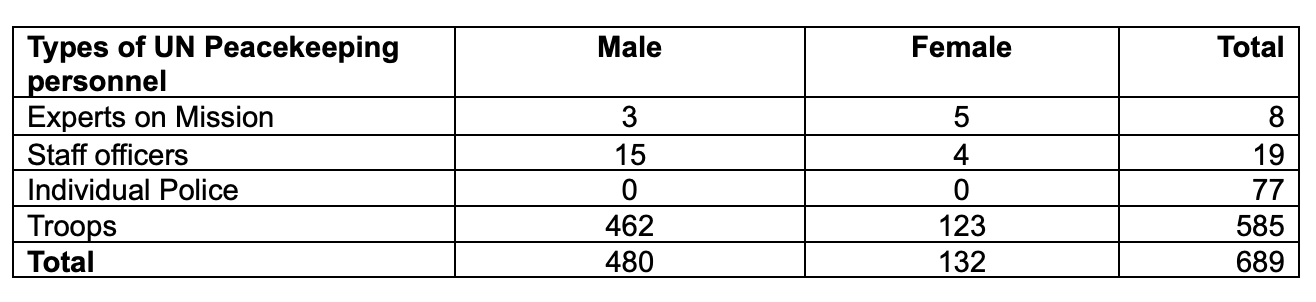
Contributions of Uniformed Personnel to UN by Country, Mission, and Personnel Type (March 2025): 05-Missions Detailed By Country
https://peacekeeping.un.org/sites/default/files/05_missions_detailed_by_country_84_march_2025.pdf
Situation Analysis Report on Women, Peace and Security in Cambodia
https://wps.asean.org/resources/situation-analysis-report-on-women-peace-and-security-in-cambodia/
UN Women’s ASEAN Press release
Internet searches used / Chat GPT
Appendix
Connection to ASEAN & Regional WPS Frameworks
Cambodia has played an active role in regional WPS efforts:
• Hosted elements of the ASEAN Regional Plan of Action on Women, Peace and Security, first launched while Cambodia was ASEAN Chair.
• Chairs the ASEAN Advisory Group on WPS, which supports localisation and technical guidance for the regional agenda.
These regional commitments provide a foundation for the national plan and help harmonise Cambodia’s policies with broader Southeast Asian priorities.
Added Value
The NAP-WPS strengthens Cambodia’s:
• Credibility as a responsible UN peacekeeping contributor
• Regional leadership on ASEAN WPS commitments
• National systems for gender-responsive security and governance
Cambodia’s Role in UN Peacekeeping & Women’s Participation
Cambodia has a notable profile within the WPS framework at regional and global levels, especially regarding peacekeeping:
Peacekeeping Contributions by Cambodia
• Cambodia has been an active contributor to UN peacekeeping operations since 2006, with thousands of personnel deployed around the world.
• Cambodian peacekeepers have served in mission areas across Africa, the Middle East and other regions.
• As of early 2025, Cambodia ranked third among ASEAN countries and ~28th globally in terms of peacekeeping personnel deployed.