


MALTA
Malta’s Second National Action Plan on Women, Peace and Security (2025-2030)
It was formally adopted and launched in December 2025, covering the period 2025–2030. It builds on Malta’s first WPS National Action Plan (2020–2024) and aligns with United Nations Security Council Resolution 1325 and related WPS commitments. The plan itself is available publicly and sets out clear aims and measurable actions.
Core Objectives & Framework (2025–2030)
Malta’s Second WPS National Action Plan (2025–2030) is structured around four core strategic pillars, each with associated aims, objectives and indicators designed to track progress.
1) Promotion of the WPS Agenda
Aim: Raise awareness and understanding — domestically and internationally — about the WPS agenda as central to peace and security policy.
Key Objectives:
• Strengthen communication, public outreach, and knowledge sharing about WPS commitments.
• Embed WPS priorities in diplomatic and international development engagements.
Example Indicators:
• Number of awareness and training campaigns delivered.
• Number and reach of public diplomacy events focusing on WPS.
Lead actors typically include the Ministry for Foreign and European Affairs and civil society partners.
2) Prevention (Gender-Based Violence & Human Trafficking)
Aim: Prevent gender-based violence (GBV), domestic violence, human trafficking, and related harms — key drivers of insecurity for women and girls.
Sample Objectives & Metrics from the Plan:
• Implement the National Strategy on Gender-Based Violence and Domestic Violence (2023-2028) (reflecting long-term policy alignment).
• Expand training for police and first responders on GBV identification and response.
• Integrate age-appropriate prevention material into school curricula.
Example Indicators:
• Number of first responders trained.
• Schools and sessions delivering educational materials.
• Reported implementation milestones against related national strategies.
Lead agencies include the Commission on Gender-Based Violence & Domestic Violence and the Malta Police Force.
3) Participation (Leadership & Decision-Making)
Aim: Enhance women’s meaningful participation and leadership in peace, governance and security decision-making.
Strategic objectives in this area aim to:
• Increase the representation of women in diplomatic and national security institutions.
• Provide opportunities for women in mediation, conflict prevention and peacebuilding roles.
• Foster pathways for women in security sectors (defence, police, peace operations).
Example indicators (from planning language):
• Number of women in leadership and representative roles in relevant ministries and security agencies.
• Participation rates of women in WPS-focused forums and training.
The Plan also anticipates improved data collection to better track participation.
4) Relief & Recovery (Support to Survivors & Vulnerable Women)
Aim: Ensure that relief, recovery and support systems are gender-responsive — especially for women and girls affected by violence, fragility and migration.
Objectives include:
• Facilitate access to tailored services for survivors of gender-based violence, including migrant and refugee women.
• Strengthen frameworks to document and respond to instances of abuse.
Example Indicators:
• Availability of safe reporting mechanisms.
• Number of support services accessible for survivors.
This pillar also integrates work with NGOs and front-line service providers.
2. Civil Society & Monitoring Structures
The 2025–2030 Plan was developed through broad consultation with civil society — including NGOs, academic experts, youth advocates, and representatives from Malta’s disciplined forces — reflecting a whole-of-government and whole-of-society approach.
The development and planned implementation of the 2025–2030 NAP emphasise broad stakeholder engagement:
• Consultative process: The Plan was drafted with inputs from government ministries, uniformed services, academia, NGOs, and civil society organisations.
• Collaborative partnerships: Malta’s WPS work explicitly involves partnerships with civil society groups, international organisations, and youth advocates — reinforcing a whole-of-government and whole-of-society approach.
• Public outreach activities: Examples include radio programmes (e.g., In-Nisa u l-Paċi), workshops with soldiers and police personnel, and awareness campaigns.
• Role of independent bodies: Institutions such as Malta’s National Commission for the Promotion of Equality (NCPE) contribute to monitoring and implementation, particularly on gender equality and discrimination issues.
Key points on CSO involvement and accountability:
• Consultations and feedback from civil society were sought in early drafting.
• An Oversight Committee will monitor implementation and include representatives from government, civil society, and academia — enhancing transparency and accountability.
• The Plan commits to strengthen partnerships with grassroots groups, especially those working with migrant and refugee women.
This inclusive process not only helps shape objectives but also provides civil society with tools to hold implementers accountable — a best practice recommended in WPS National Action Plans.
This marks a step beyond the first NAP (2020–2024), which also emphasised joint government–civil society implementation but had less publicly documented monitoring.
Women’s Roles in Malta’s Security Sectors
While comprehensive, disaggregated data for Malta’s specific security sectors are not centrally published in the Plan itself, there are some contextual indicators and broader patterns:
Police
• The Malta Police Force is the national civil security institution with over 2,400 sworn officers.
• Malta has reported progress in increasing gender diversity within police specialisations (e.g., women in forensic roles), though overall representational statistics (e.g., percentage of women in command roles) vary by unit.
Armed Forces & Defence
• Malta’s military (Armed Forces of Malta) is relatively small and traditionally has lower female representation. The NAP’s participation pillar highlights the need to foster women’s leadership in defence and security, but specific baseline figures aren’t detailed in the public plan text.
Peacekeeping & International Missions
• Malta contributes personnel to international peace and security efforts through EU and UN missions, but like many countries, the share of women in peacekeeping roles (military, police, civilian) remains below gender parity benchmarks. Globally, women have traditionally been underrepresented in peacekeeping troops and command positions, despite agreed targets (e.g., increasing percentage of female police and military staff).
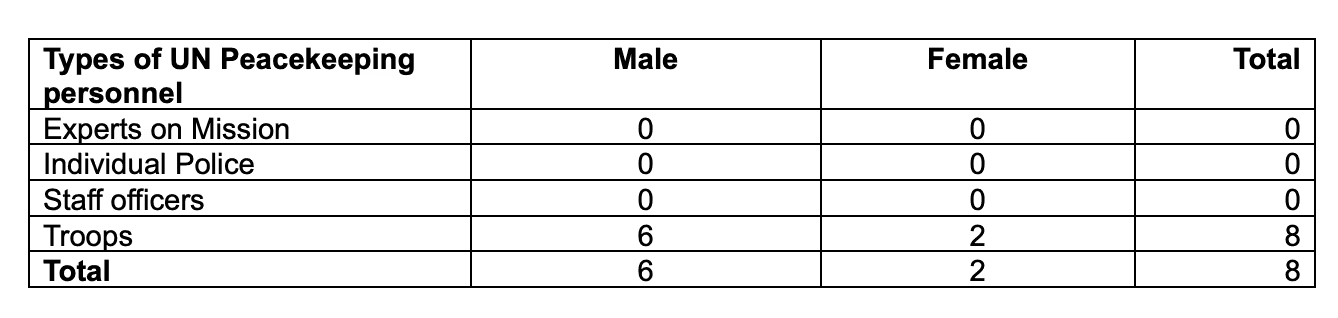
UN peacekeeping statistics:
As of March 31, 2025, Malta has contributed 8 personnel for peacekeeping missions ( of which only 2 are women).
Malta’s ranking as a contributor of personnel to UN peacekeeping missions: 98
4. Monitoring & Indicators
Unlike some other countries’ WPS NAPs that publicly map detailed indicators, Malta’s document links many of its objectives to implementation of complementary national strategies (e.g., GBV & Domestic Violence Strategy) and tracks progress through entity-level reporting and committees.
Some indicator areas include:
• Training outputs (e.g., police, first responders).
• Educational interventions (e.g., curriculum sessions on healthy relationships).
• Collaborative forums convened.
• Participation counts (women in leadership roles or WPS events).
• Service access for survivors and vulnerable groups.
Formal annual or mid-term public reporting may emerge as the Plan enters implementation; early oversight meetings will likely establish baselines and tracking methodologies.
Additional Context — WPS Indicators for Malta
While not part of the NAP text, broader indices like the Women Peace and Security Index offer contextual data on how Malta performs overall in dimensions of women’s inclusion, security, and justice. As of 2026, Malta’s WPS Index score was 0.841, indicating relatively strong outcomes, though with room for progress.
References:
Contributions of Uniformed Personnel to UN by Country, Mission, and Personnel Type (March 2025): 05-Missions Detailed By Country
https://peacekeeping.un.org/sites/default/files/05_missions_detailed_by_country_84_march_2025.pdf
Malta Second NAP 2025-2030
https://wpsfocalpointsnetwork.org/wp-content/uploads/2026/02/WPS-Web-Jan2026.pdf