


Malaysia’s National Action Plan on Women, Peace & Security (NAP WPS) 2025–2030
Malaysia launched its first-ever NAP WPS on 9 September 2025, marking a major national and ASEAN‑level milestone.
Core Purpose
The NAP WPS 2025–2030 is Malaysia’s first comprehensive framework aligned with UNSCR 1325 and subsequent WPS resolutions. It aims to ensure that women are empowered, protected, and meaningfully included across all peace and security processes.
Objectives of Malaysia’s NAP WPS 2025–2030
Across government statements and the plan’s abstract, several strategic objectives emerge:
a. Strengthen Women’s Participation in Peace & Security
• Ensure women’s meaningful participation in decision‑making in security institutions and peace processes.
• Position women as agents of prevention, protection, and recovery in both traditional and non‑traditional security threats (e.g., climate change, cyber insecurity, pandemics).
b. Enhance Protection from Violence
• Address sexual and gender‑based violence (SGBV) and improve protection mechanisms in crises and conflict‑affected contexts.
c. Integrate Gender Across National Security Policies
• Embed WPS principles into national development, disaster response, and security strategies.
• Complement the National Women’s Policy 2025–2030.
d. Promote Inclusive, Whole‑of‑Society Security
• Strengthen collaboration across ministries, civil society, and communities to build a safer and more inclusive Malaysia.
Civil Society Involvement
Malaysia’s NAP WPS was developed through extensive multi‑stakeholder consultations, explicitly including civil society organisations (CSOs).
Key elements of CSO involvement include:
a. Participatory Development Process
• The plan was shaped through broad consultations involving women’s organisations, peacebuilding groups, and community actors.
b. Whole‑of‑Society Implementation
• Government statements emphasise that the NAP WPS reflects a whole‑of‑government and whole‑of‑society effort.
c. Alignment with ASEAN WPS Norms
• Malaysia’s approach mirrors ASEAN’s emphasis on CSO engagement in WPS implementation, reinforced by its 2025 ASEAN Chairmanship theme:
“Towards an Inclusive and Sustainable ASEAN Community.”
The emphasis on multi‑stakeholder collaboration suggests that CSOs will play roles in implementation, monitoring, advocacy, and community‑level programming.
Women’s Roles in Malaysia’s Security Sectors
Available reporting provides insight into women’s participation in peacekeeping, with more limited public data on policing and military roles.
a. Women in Peacekeeping
Malaysia has a long peacekeeping history, and women’s participation has recently expanded:
• Women comprise 10.5% of Malaysia’s UNIFIL (Lebanon) contingent, nearly double the global average.
• In 2024–2025, Malaysia recorded its largest deployment of female peacekeepers, with 85 women sent to UNIFIL.
• This achievement earned Malaysia a special award at the 2025 UN Peacekeeping Ministerial in Berlin.
These figures position Malaysia as a regional leader in women’s peacekeeping participation.
b. Women in the Military
While the NAP WPS highlights the need to increase women’s participation, publicly available data in the retrieved sources does not provide specific percentages for women in the Malaysian Armed Forces.
However, the government emphasises:
• The importance of women as leaders in community resilience and crisis response.
• The integration of gender perspectives into defence and security planning.
c. Women in Policing
The retrieved sources do not provide quantitative data on women in the Royal Malaysia Police (PDRM).
However, the NAP WPS framework includes:
• Strengthening gender‑responsive policing and protection services.
• Enhancing women’s leadership and participation in security institutions more broadly.
d. Women in Other Security Roles
The NAP WPS also addresses:
• Cybersecurity
• Trafficking in persons
• Disaster response
• Violent extremism prevention
These areas are framed as emerging security domains where women’s participation is essential.
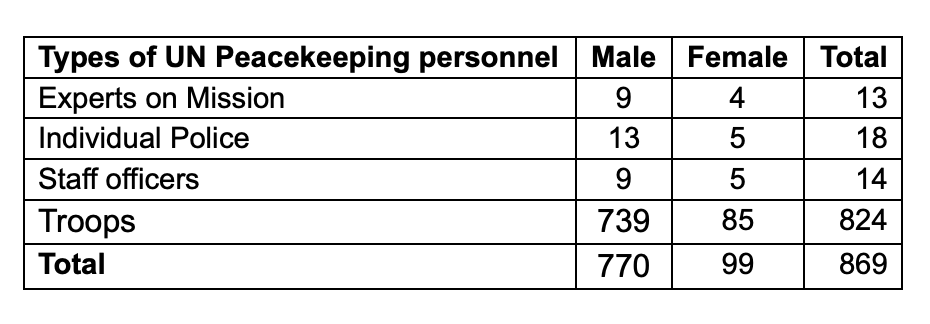
UN Peacekeeping as of 31 March 2025
As of March 31, 2025, Malaysia contributed 9 Peacekeeping personnel (of which 132 were female):
Cambodia’s ranking as a contributor of personnel to UN peacekeeping missions: 21
Summary
Malaysia’s first NAP WPS (2025–2030) represents a major step in institutionalising gender‑responsive security. It:
• Establishes clear objectives for women’s participation, protection, and leadership.
• Embeds WPS principles across national security and development policies.
• Was developed through broad civil society engagement.
• Highlights Malaysia’s growing leadership in women’s peacekeeping, with strong deployment numbers and international recognition.
• Signals intent to expand women’s roles in policing, military, and non‑traditional security sectors, though public data remains limited.
References
Malaysia’s National Action Plan on Women, Peace & Security (NAP WPS) 2025–2030
https://wpsfocalpointsnetwork.org/wp-content/uploads/2025/09/NAP-WPS-Malaysia_compressed.pdf
Contributions of Uniformed Personnel to UN by Country, Mission, and Personnel Type (March 2025): 05-Missions Detailed By Country https://peacekeeping.un.org/sites/default/files/05_missions_detailed_by_country_84_march_2025.pdf